Identification of Plasma Inflammatory Markers of Adolescent Depression Using the Olink Proteomics Platform
'自我成长类播客'如The School of Greatness #生活知识# #心理建议# #心理自助资源#
Actions
. 2023 Oct 11:16:4489-4501.
doi: 10.2147/JIR.S425780. eCollection 2023.
Maolin Cao 3 , Jing Tian 1 , Peijin Cui 1 , Ling Ai 3 , Xue Li 4 , Hua Li 5 , Menghan Gao 1 , Liang Fang 1 2 6 , Libo Zhao 1 2 , Fang Gong 2 6 , Chanjuan Zhou 1 3 4 6
Affiliations
PMID: 37849645 PMCID: PMC10577244 DOI: 10.2147/JIR.S425780Identification of Plasma Inflammatory Markers of Adolescent Depression Using the Olink Proteomics Platform
Ling Yang et al. J Inflamm Res. 2023.
Abstract
Purpose: The quality of life of worldwide adolescents has been seriously affected by depression. Notably, the inflammatory response is closely associated with the pathophysiology of depression. The present study applied a novel targeted proteomics technology, Olink proximity extension assay (PEA), to profile circulating immune-related proteins in adolescents with depression.
Methods: In the present study, the expression levels of 92 inflammation-related proteins were compared between adolescents with depression (ADs) (n=15) and healthy controls (HCs) (n=15), using the OLINK PEA inflammation panel. We further validated 5 top proteins that were identified through KEGG and GO analyses between 40 HCs and 50 ADs, including CCL4, CXCL5, CXCL6, CXCL11, and IL-18 using enzyme linked immunosorbent assay (ELISA).
Results: We identified 13 differentially expressed proteins between the two cohorts, including 5 up-regulated and 8 down-regulated proteins. Among them, the TRAIL protein levels were significantly negatively correlated with the HAMA-14 score (r=-0.538, p= 0.038), and the levels of transforming growth factor α (TGF-α) were significantly associated with a change in appetite (r = -0.658, p = 0.008). After validation by ELISA, CCL4, CXCL5, CXCL11, and IL-18 showed significant changes between ADs and HCs (p < 0.05), while CXCL6 showed an up-regulated tendency in ADs (p=0.0673). The pooled diagnostic efficacy (area under the curve [AUC]) of these five inflammation markers in clinical diagnosis for adolescent depression was 0.819 (95% CI: 0.735-0.904).
Conclusion: We report a number of inflammation-related plasma biomarkers, which uncover a potential involvement of chemokines, cytokines, and cytokine receptors in adolescent depression. Their roles in the pathophysiology of depression need to be further elucidated.
Keywords: adolescent depression; biomarkers; inflammation; olink proximity extension assay.
© 2023 Yang et al.
PubMed Disclaimer
Conflict of interest statement
The authors report no conflicts of interest in this work.
Figures
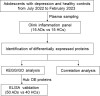 Figure 1
 Flow-chart of inflammation-related markers identification in adolescents with depression.
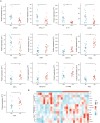 Figure 2
 Differential expressed protein levels between adolescents with depression (ADs) and healthy controls (HCs). (A) Scatter plot of the 13 differentially expressed proteins. (B) Heatmap of 13 differentially expressed proteins. Significance levels: *P < 0.05, **P < 0.01, ***P < 0.001.
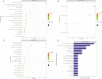 Figure 3
 Gene Ontology (GO) and Kyoto Encyclopedia of Genes and Genomes (KEGG) enrichment analysis of the differentially expressed proteins. GO enrichment analysis showed the most relevant (A) biological process, (B) cellular component biological process, and (C) molecular function terms related to the differentially expressed proteins. (D) KEGG enrichment analysis showed the top enriched pathway of the differentially expressed proteins.
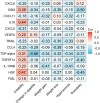 Figure 4
 Relationship between DEP levels and the depressive symptoms in adolescents with depression.
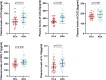 Figure 5
 Elisa validation of plasma CCL4, CXCL5, CXCL6, CXCL11, and IL-18 levels in adolescents with depression (ADs) and healthy controls (HCs).
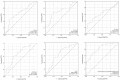 Figure 6
 Receiver operating characteristic (ROC) curve for CCL4, CXCL5, CXCL6, CXCL11, IL-18, and the five-protein combination.
Similar articles
Elevated levels of several chemokines in the cerebrospinal fluid of patients with subarachnoid hemorrhage are associated with worse clinical outcome.
Vlachogiannis P, Hillered L, Enblad P, Ronne-Engström E.Vlachogiannis P, et al.PLoS One. 2023 Mar 9;18(3):e0282424. doi: 10.1371/journal.pone.0282424. eCollection 2023.PLoS One. 2023.PMID: 36893189Free PMC article.
Plasma Olink Proteomics Identifies CCL20 as a Novel Predictive and Diagnostic Inflammatory Marker for Preeclampsia.
Wang X, Yip KC, He A, Tang J, Liu S, Yan R, Zhang Q, Li R.Wang X, et al.J Proteome Res. 2022 Dec 2;21(12):2998-3006. doi: 10.1021/acs.jproteome.2c00544. Epub 2022 Oct 27.J Proteome Res. 2022.PMID: 36301636Free PMC article.
Targeted proteomics profiling reveals valuable biomarkers in the diagnosis of primary immune thrombocytopaenia.
Jiang Y, Li J, Huang J, Zhang Z, Liu X, Wang N, Huang C, Wang R, Zhang L, Han J, Bai X, Huang D, Zhou L.Jiang Y, et al.Br J Haematol. 2025 Jan;206(1):133-143. doi: 10.1111/bjh.19760. Epub 2024 Sep 23.Br J Haematol. 2025.PMID: 39313912
Olink proteomics profiling platform reveals non-invasive inflammatory related protein biomarkers in autism spectrum disorder.
Bao XH, Chen BF, Liu J, Tan YH, Chen S, Zhang F, Lu HS, Li JC.Bao XH, et al.Front Mol Neurosci. 2023 May 24;16:1185021. doi: 10.3389/fnmol.2023.1185021. eCollection 2023.Front Mol Neurosci. 2023.PMID: 37293545Free PMC article.
Methods and clinical biomarker discovery for targeted proteomics using Olink technology.
Wang H, Zhao T, Zeng J, Zhang R, Pu L, Qian S, Xu S, Jiang Y, Pan L, Dai X, Guo X, Han L.Wang H, et al.Proteomics Clin Appl. 2024 Sep;18(5):e2300233. doi: 10.1002/prca.202300233. Epub 2024 May 10.Proteomics Clin Appl. 2024.PMID: 38726756Review.
Cited by
Olink proteomics reveals TNFRSF9 as a biomarker for abdominal aortic aneurysms.
Chang R, Wang H, Lu C, Chen J, Li Y, Qiao M, Gao S, Li L, Fan K, Zhang R, Dong H.Chang R, et al.iScience. 2025 Jun 5;28(7):112828. doi: 10.1016/j.isci.2025.112828. eCollection 2025 Jul 18.iScience. 2025.PMID: 40599317Free PMC article.
Association of circulating immune cell phenotypes and peripheral inflammatory biomarkers with depressive symptoms in the Framingham Heart Study.
Iyer S, Cao Y, Liebegott R, Chen J, Ragab A, Doyle MF, Lunetta KL, Murabito JM.Iyer S, et al.Psychoneuroendocrinology. 2026 Feb;184:107716. doi: 10.1016/j.psyneuen.2025.107716. Epub 2025 Dec 2.Psychoneuroendocrinology. 2026.PMID: 41349492Free PMC article.
Cytokine-Related Genes and Inflammatory Profiles as Potential Biomarkers in Major Depressive Disorder.
Oh H, Kong NY, Jung SW, Kim HC, Kim S, Kang J, Lee H.Oh H, et al.Psychiatry Investig. 2025 Aug;22(8):858-869. doi: 10.30773/pi.2025.0013. Epub 2025 Jul 31.Psychiatry Investig. 2025.PMID: 40738168Free PMC article.
Plasma inflammation-related proteins associated with anxiety and depression disorders in IBD patients.
Zhou MS, Zhang WR, Dang Y, Xu F, Xu CY, Wang Z, Wang CSE, Zhu SY, Li P, Wu J, Shi HY.Zhou MS, et al.Sci Rep. 2025 May 27;15(1):18445. doi: 10.1038/s41598-025-03543-1.Sci Rep. 2025.PMID: 40419679Free PMC article.
Seasonal Proteomic Variations and Biomarkers in Seasonal Allergic Rhinitis: Insights from Olink Inflammation Profiling.
Shen J, Zheng X, Yan M, Feng M, Ding C, Xie S, Xu H.Shen J, et al.J Inflamm Res. 2025 May 12;18:6191-6202. doi: 10.2147/JIR.S519126. eCollection 2025.J Inflamm Res. 2025.PMID: 40386182Free PMC article.
References
Disease GBD, Injury I, Prevalence C. Global, regional, and national incidence, prevalence, and years lived with disability for 328 diseases and injuries for 195 countries, 1990-2016: a systematic analysis for the Global Burden of Disease Study 2016. Lancet. 2017;390(10100):1211–1259. - PMC - PubMed Zhou X, Teng T, Zhang Y, et al. Comparative efficacy and acceptability of antidepressants, psychotherapies, and their combination for acute treatment of children and adolescents with depressive disorder: a systematic review and network meta-analysis. Lancet Psychiatry. 2020;7(7):581–601. doi: 10.1016/S2215-0366(20)30137-1 - DOI - PMC - PubMed Mokdad AH, Forouzanfar MH, Daoud F, et al. Global burden of diseases, injuries, and risk factors for young people’s health during 1990-2013: a systematic analysis for the Global Burden of Disease Study 2013. Lancet. 2016;387(10036):2383–2401. doi: 10.1016/S0140-6736(16)00648-6 - DOI - PubMed Cipriani A, Zhou X, Del Giovane C, et al. Comparative efficacy and tolerability of antidepressants for major depressive disorder in children and adolescents: a network meta-analysis. Lancet. 2016;388(10047):881–890. doi: 10.1016/S0140-6736(16)30385-3 - DOI - PubMed Teng T, Zhang Z, Yin B, et al. Effect of antidepressants on functioning and quality of life outcomes in children and adolescents with major depressive disorder: a systematic review and meta-analysis. Transl Psychiatry. 2022;12(1):183. doi: 10.1038/s41398-022-01951-9 - DOI - PMC - PubMedLinkOut - more resources
Full Text Sources
Atypon Dove Medical Press Europe PubMed Central PubMed CentralMiscellaneous
NCI CPTAC Assay Portal网址:Identification of Plasma Inflammatory Markers of Adolescent Depression Using the Olink Proteomics Platform https://klqsh.com/news/view/321888
相关内容
Identification of Plasma Inflammatory Markers of Adolescent Depression Using the Olink Proteomics Platform[Article Metrics] Identification of Plasma Inflammatory Markers of Adolescent Depression
The Role of Sclerostin in Bone Diseases
Machine learning for the prediction of sepsis: a systematic review and meta
Updated Guidelines for the Orthodontic Management of Traumatized and Endodontically Treated Teeth: A Review Study
The birth of the Eiffel Tower
Prevalence of frailty in 62 countries across the world: a systematic review and meta
亲子关系和父母教育卷入对青少年抑郁、自伤和自杀意念的影响:挫败感和人生意义感的作用
Health Effects of Climate and Air Pollution in Buenos Aires: A First Time Series Analysis
know your registration number of pm kisan samman nidhi? – AgriBot
随便看看
最新乐趣
- 雍正派李卫赐死年羹尧,黄马褂守城门成导火索
- 深度解析《雍正王朝》 十三爷去劝说老十四回京效力,结果差点被气死
- 下一站是幸福:真担心繁星的凶悍,会吓跑元宋
- 《卿卿日常》:隐藏了多少秘密,白敬亭的腹肌,田曦薇的身材
- 直到去西藏玩了后,才真切的感觉到文成公主是真的牛
- 嗯?听说有人说是戏精
- 情敌变情人,就突然发现郝葭和夫人好有cp感
- 甄嬛传剧组穷到手机拍摄 龙袍日租十块
- 农村婆婆进城屡次闯祸最后连儿子的家都搞没了
- 进忠的伞一斜,便许魏嬿婉一世荣华
热点乐趣
- 89753
- 78058
- 64255
- 60316
- 39827
- 35838
- 32528
- 22833
- 22752
- 21537